Building Agentic Organizations
The Self-Learning Organization.
How to build an organization whose systems fit themselves to its people and keep learning: its knowledge, its agents, its websites, and its dashboards. Taught through how we are building the Global Student Startup Foundation. By Mike Lee.
A working draft. Chapters appear here as they are written; the pilot is Fall 2027. The book follows Building AI Agents, which teaches the foundations.
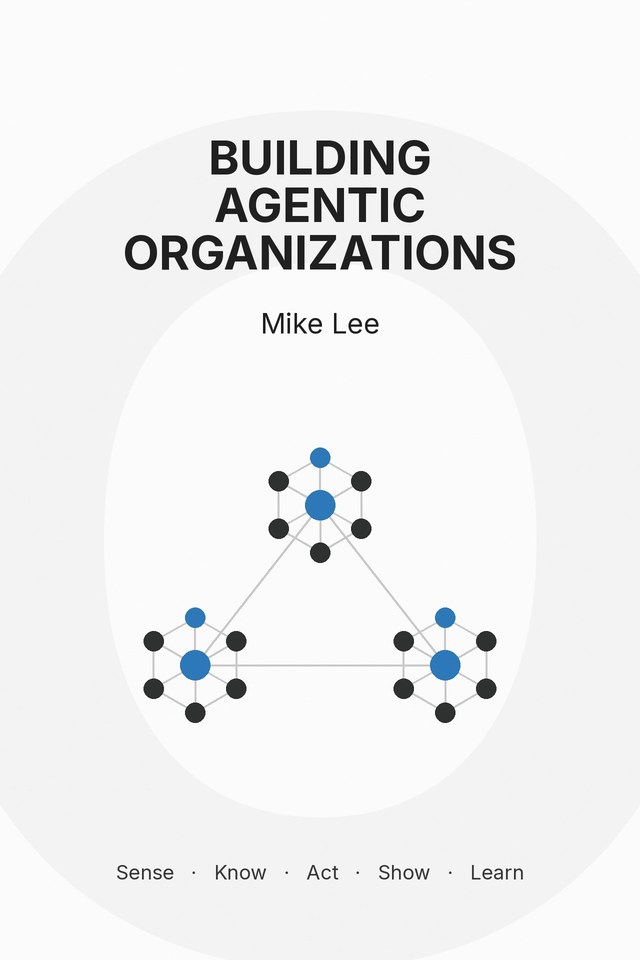
Sense. Know. Act. Show. Learn.
A self-learning organization runs one cycle, carried by four systems: knowledge, agents, websites, and dashboards. Every part of the book builds one step, and every exercise builds it for your own organization.
A real organization
Taught through how we are building GSSF, including what went wrong and what we changed.
Build or lead
Every chapter has two tracks: set it up yourself, or design and decide what to build.
A living book
The book is itself a self-learning organization: it changes as we, and our readers, learn.
Rigid systems. Living organizations.
Traditional systems make the organization fit the system. An agentic organization fits itself to the organization, and to each person in it, and keeps learning.
| Traditional systems | An agentic organization | |
|---|---|---|
| Change | A project: planning, migration, training | Continuous: the system reorganizes itself, and people approve |
| Fit | The organization adapts to the system | The system adapts to the organization |
| People | Everyone gets the same screens and training | Each person's agent guides them individually |
| Knowledge | Goes stale unless someone maintains it | Rationalized with every addition |
Twenty chapters. Six parts.
From what makes an organization self-learning to the workforce it creates.
The Living Organization
- 1The Self-Learning Organization
- 2Designing the Organization
It Senses and Knows
- 3Every Channel, One Organization
- 4Living Knowledge
- 5Knowledge Domains and Standard Assets
- 6Rationalizing Knowledge
- 7Frozen Records and Institutional Memory
- 8From Strategy to Execution
It Acts
- 9An Agent for Every Person
- 10Agents Working Together
- 11Policy, Trust, and Security
It Shows
- 12Websites
- 13The Organization Dashboard
- 14Personal Dashboards and Self-Service
It Learns
- 15Audit and the Three Lines
- 16Observability, Privacy, and Cost
- 17How the Organization Improves Itself
- 18Operating Through Failure
Beyond One Organization
- 19Agents Across Organizations
- 20The Workforce of the Future
Written for builders and leaders.
No programming background is assumed. Your agent does the technical work; you decide and approve.
Students
Who have finished Building AI Agents, in any major, building for a real organization.
MBA students
Who will lead organizations, with a track for designing, deciding, and making the case.
Leaders
Founders and nonprofit and program leaders with a strategy and too few people.
Instructors
Looking for a text where students build and run something real.
Designed to be taught.
Each student or team builds for a real organization: a club, a startup, a partner nonprofit, or a GSSF chapter. Every chapter follows one rhythm.
- What we needed at GSSF
- The model, named, with its framework
- How we automated it
- What went wrong, and what we changed
- Build: set it up for your organization
- Lead: design and decide for your organization
- Field Notes: what we have learned since
What students build with
The tools a real organization runs on: an AI agent for every person (Claude Code), knowledge in Git with access levels behind one gatekeeper, GitHub, websites and sign-in lists on Cloudflare, and Slack, email, and Google Workspace as channels.
Students teach the book too
At the end of a course, each team writes a short pattern report. We test the best ideas at GSSF or in another organization, and what works enters the book with credit to the students who found it.
A book that learns.
The online edition changes whenever we learn something. Each January edition is frozen, so courses can cite it. Every model in the book says how far it has been tested.
The AI Workforce of the Future series.
Four books from GSSF Press, a program of the Global Student Startup Foundation: the foundations of AI, building your own AI Team, building whole organizations of AI agents and people, and building AI startups.
AI Fundamentals
A first course in artificial intelligence, by Nitin Kalé.
January 2027
Building AI Agents
Building your own AI Team: AI co-workers who work for you, safely. By Mike Lee.
Visit the book →The foundations
Building Agentic Organizations
The self-learning organization: knowledge, agents, websites, and dashboards that fit themselves to their people and keep learning. By Mike Lee.
Visit the book →This book · Pilot, Fall 2027
Building AI Startups
A startup bootcamp: from idea to validation, pitch, and launch. By Bob Upham.
ForthcomingGSSF Press. We make AI education accessible to undergraduate students regardless of financial ability or location, so every student can build with AI.